
Hand Stitching vs. Machine Stitching: The True Meaning of Choosing the Right Technique for Leather Products
The quality of leather products is often reduced to a single word: hand stitching. However, this expression alone is not an indicator of quality. The real determinant is how well the stitching technique aligns with the product's use case, the mechanical stress it's subjected to, and its long-term aging behavior. Therefore, the right question isn't "hand stitching or machine stitching?" The right question is, which stitching technique is technically more appropriate for which product.
When is Machine Stitching the Best Choice?
Machine stitching is an extremely rational choice, especially for leather products with a fixed form, that do not carry loads, and are not subjected to continuous bending-straightening cycles. In products like watch boxes and cigar cases, the stitch line does not bear structural load; it primarily plays a role in stabilizing the form and maintaining aesthetic integrity. In these products, high-quality machine stitching ensures homogeneous thread tension, microscopic accuracy in continuous lines, and clean corner turns. Therefore, in this context, machine stitching is not a convenience, but a conscious design and engineering choice.
Where is Hand Stitching (Saddle Stitch) Indispensable?
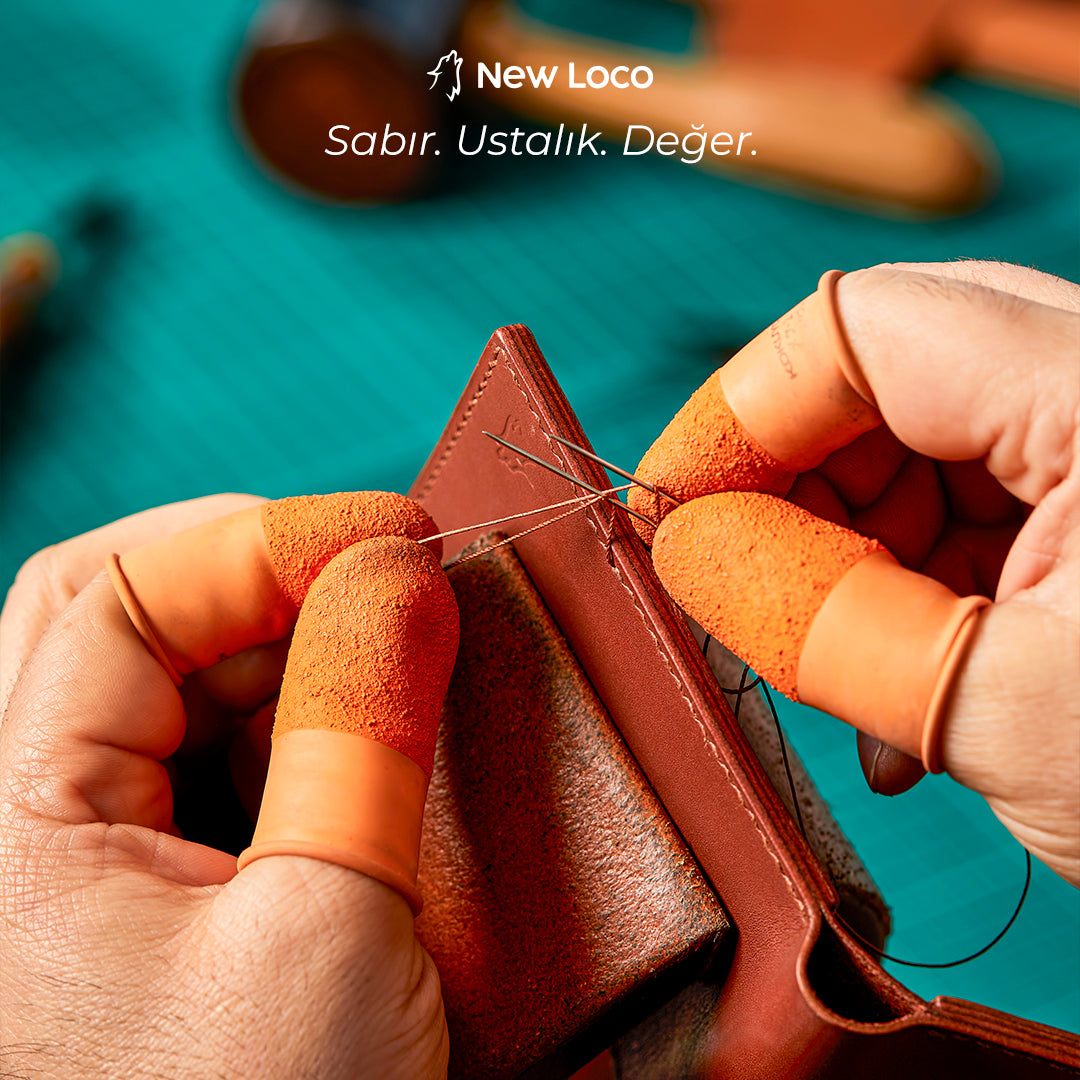
Hand stitching, especially when applied with the traditional two-needle technique known as saddle stitch, becomes indispensable for products that are in constant motion, folding, and subjected to mechanical stress in daily use. In products such as wallets, belts, and watch straps, the independent stitch structure created with two needles prevents a single breakage from affecting the entire line. Over time, the stretching that occurs in the leather allows the stitch line to age in a controlled manner along with it, rather than weakening it.
The Role of Thread in Hand Stitching: Meisi Japanese Waxed Polyester Thread
The true strength of hand stitching lies not only in the technique but also in the thread used. At New Loco, Meisi brand Japanese waxed polyester thread is preferred for hand-stitched products. Meisi threads offer high tensile strength, low stretch ratio, and resistance to abrasion. Thanks to its waxed structure, the thread moves smoothly through the leather fibers; over time, the wax layer penetrates the leather, increasing the stability and lifespan of the stitch line. Its polyester-based structure ensures that the thread maintains its form under conditions of moisture, temperature changes, and long-term use.
Where is the Wrong Comparison Made?
A common mistake in the market is to present hand stitching as an absolute superiority for every product. This is not technically correct. When hand stitching is used in the wrong product group, it does not provide aesthetic advantages, can disrupt visual balance in some forms, and creates unnecessary costs. True quality is not about producing every product with the same method; it's about being able to choose the right method for each product.
New Loco’s Technical Approach
At New Loco, the stitching method is not a marketing statement but a technical decision that determines the product's character. Therefore, classic wallets, belts, and watch straps that are subjected to high mechanical stress in daily use are produced entirely with hand stitching, using the saddle stitch technique and Meisi brand Japanese waxed polyester threads. In contrast, for products with a fixed form and high aesthetic sensitivity, such as watch boxes and cigar cases, high-quality machine stitching is preferred. This approach is not cost-driven, but rather focused on product lifespan and function.

Conclusion: Quality is Not the Technique Itself, But Its Correct Application
The quality of a leather product is not understood solely by the phrase "hand-stitched." True quality emerges when it can be technically explained why it was hand-stitched or why machine stitching was preferred. Real craftsmanship is not about making every product the same way; it's about being able to make every product as it should be. This difference becomes evident not at first glance, but years later when looking at the product.

Paylaş:
What is LWG Gold Certification? Why Does New Loco Use It?
What Is Patina? Why Does Vegetable-Tanned Leather Become More Beautiful Over Time?